
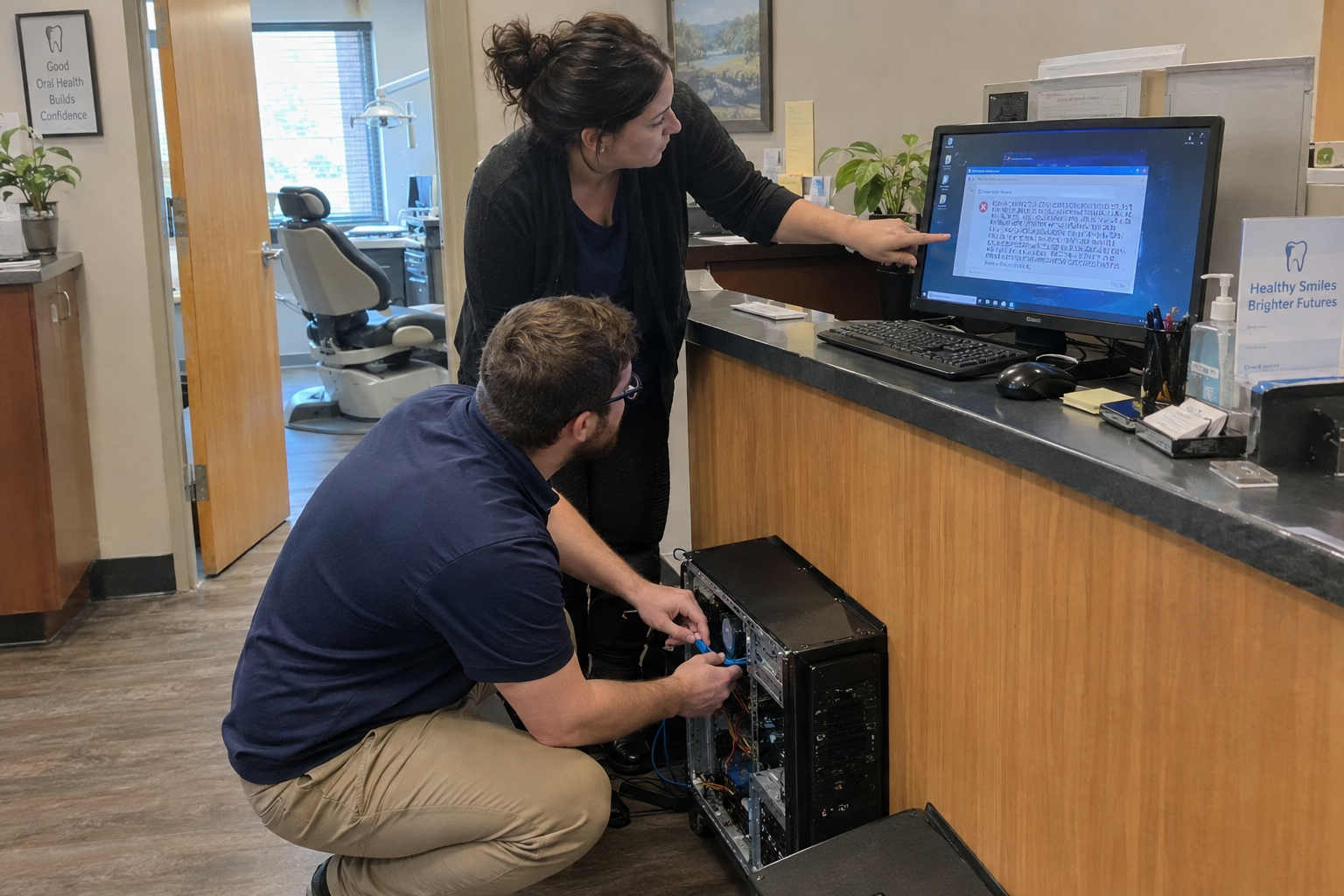
You're at a chamber mixer and someone asks what your MSP does. You launch into the list: IT, security, cloud, help desk, backup, maybe some cabling. Their eyes go somewhere past your shoulder. You know the look.
Your pitch is blurry because your service list grew organically, client by client, year by year. Not because you're unclear. The fix doesn't start with the services. It starts with naming the client you serve best.
"We do IT, security, cloud, and help desk for small businesses" becomes "We keep dental practices compliant and online." One names a person. The other names a list.
Why Your Pitch Sounds Like Everyone Else's
Every service you added made sense at the time. A client asked for it, you said yes, and it became part of what you say you do. That's how a five-person shop ends up pitching twelve services and sounding exactly like the other twelve shops in your metro.
A list isn't a pitch. A list is a menu, and menus don't get clients to say "that's us." What gets that reaction is a sentence that names the specific kind of business you understand better than anyone else in the room.
So how do you figure out which client that is? You don't start with a whiteboard and a strategy session. You start with your invoices.
How to Find the Client You Serve Best
Pull your top ten clients by revenue, or by the ones you'd never want to lose. Look at what they have in common. Industry, size, the problem they came to you with, the reason they stay. The thread is usually right there.
Say you run a 20-person MSP. Your top ten includes four dental offices, all with ten to thirty chairs, all with the same compliance headaches and the same x-ray software that needs babysitting. The other six are a grab bag: a bakery, a law firm, a nonprofit. You know which four you'd fight to keep.
That's your client. Not the one who pays the most. The one you serve so well that the work feels easy and the renewals feel automatic. The one you'd rather have five more of than one more of the bakery.
If no thread emerges, pick the client you enjoy serving most and reverse-engineer it. What is it about them? The size, the compliance burden, the fact that they actually follow your advice? That's a thread too.
Once you've named that client, the sentence writes itself.
Writing the One-Sentence Offer
Use this structure: "We provide [service] to [client type] who struggle with [specific problem]."
"We provide managed IT and compliance to dental practices who struggle with HIPAA audits."
Say it out loud. If it mentions more than one type of client or more than one core service, cut it down. "Small businesses" is not a client type, it's a category. "Dental practices with ten to thirty chairs" is a client you can picture.
If your services are so intertwined that cutting one breaks the others, frame the sentence around a bundled outcome instead. "We keep dental practices compliant and online" names the result, not the stack behind it.
This sentence is a choice. It tells the room who you are, and it tells a lot of other people that you're not for them. That's the point. Now the hard part: what happens to the services that don't fit.
What to Do With the Services That Don't Fit
Rank every service you sell by one question: does it support the sentence? Not "does it make money", not "have we always done it". Does it help the dental practice stay compliant and online?
The ones that don't support it fall into two groups. Some rarely sell and drain skills you don't have; those are candidates to cut outright. Others are profitable but muddy, like that web design you've kept since 2019. My view: don't cut the profitable ones cold. Demote them.
Make them add-ons for existing clients, not part of the core pitch. Keep selling web design to the clients who already trust you. Just stop leading with it. The new prospect hears the sentence, not the menu.
Be honest about the cost. Cutting or demoting services can mean short-term revenue loss. Some services are locked into contracts you'll need to exit or phase out over time, not sever on a Friday. That's fine. The sentence is a direction, not a deadline.
And if your revenue genuinely depends on a service that doesn't fit the sentence, you have a choice to make. Not about the sentence. About the business you actually want to run.
When the One-Sentence Approach Won't Work
This approach fails in three situations. Know them before you start.
- Your best-fit clients are too diverse to share a thread. Healthcare, retail, and nonprofits that each need something different won't fit one sentence. You either pick a vertical and accept the work you'll turn away, or you keep a broader pitch and accept the blur.
- Your revenue depends on a muddy service. If cutting web design means losing your biggest contract, you can't cut it this quarter. Phase it out, but be clear with yourself that the sentence stays blurry until it's gone.
- You're not willing to turn away work that doesn't fit. The sentence only works if you can say no to the bakery. If you can't, you'll drift back to the list.
None of these are failures of will. They're business realities. The sentence approach asks for a strategic choice, not a reactive one, and not every shop is in a position to make it today.
Your Next Step: Test It on a Real Prospect
Before you touch your website or your LinkedIn banner, use the sentence in your next sales conversation. Say it to a dental prospect and watch what happens.
If they respond with recognition, "oh, you handle our HIPAA stuff," you're there. If they ask "what exactly do you do?" you haven't cut enough.
One prospect isn't a verdict. But it's a start. Get the sentence right on a real call, then update the materials. The order matters: the sentence earns its place in the pitch before it earns its place on the page.

mspoutpost.com/articles/the-one-sentence-that-tells-a-prospect-exactly-what-your-msp-does
Written by Natalie Brandt
MSP Outpost publishes information, not legal, financial, insurance, tax or compliance advice, and reading it creates no professional relationship. For decisions about your business, talk to a qualified professional.